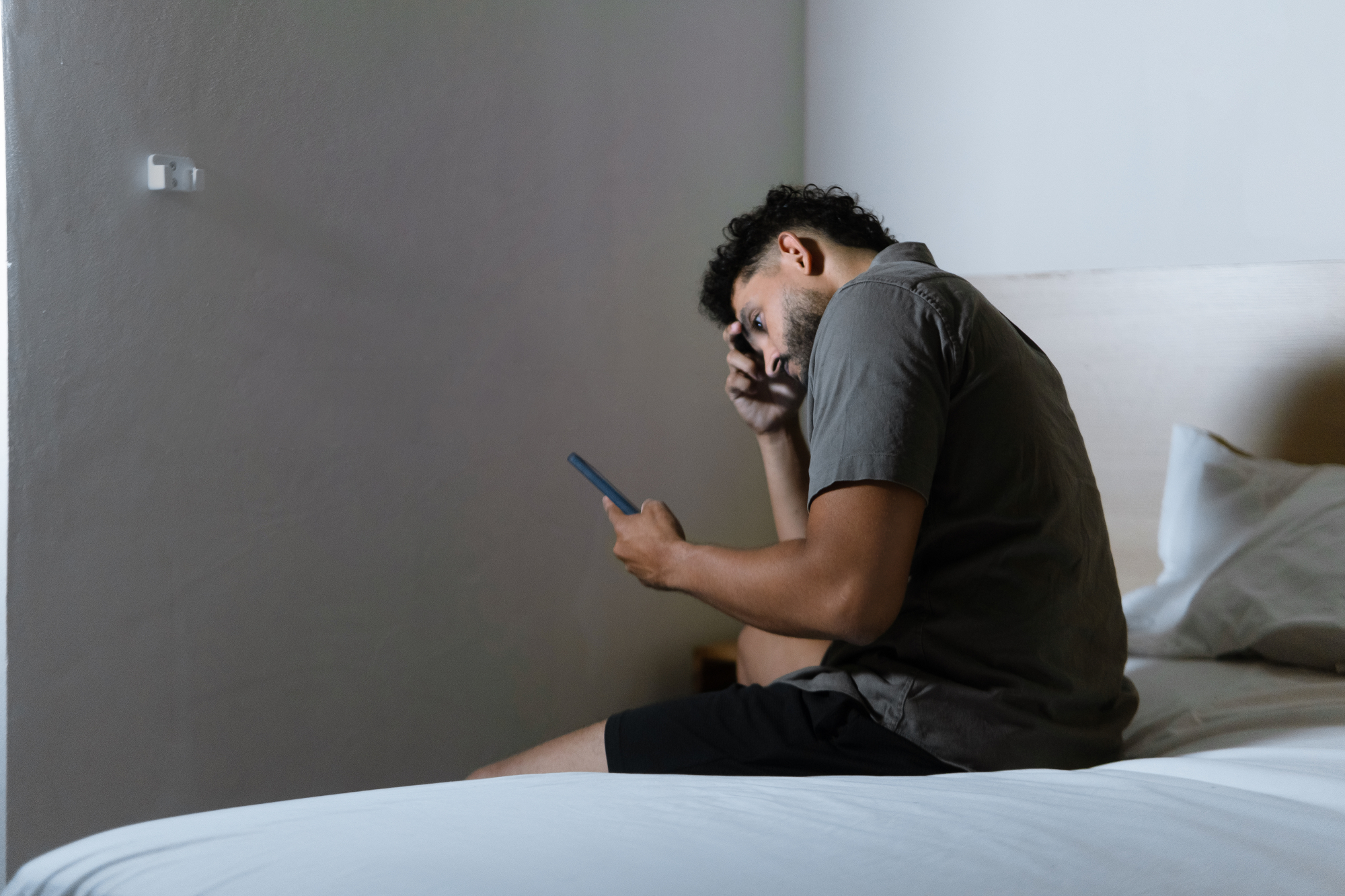
As heightened uncertainty persists across the Gulf region, many are understandably finding it hard to stay offline. But there’s a fine line between staying informed and being consumed.
In a new episode of Wellbeing at Work, a podcast by Workplace Options, a TELUS Health company, Vice President and General Manager of Emerging Solutions Sarah Woods sits down with clinical psychologist Marianne Khlat to discuss the psychological impact of doomscrolling in times of crisis, and how individuals can stay informed without becoming overwhelmed.
Read an excerpt from their conversation below:
Sarah: To start us off, I was wondering, Marianne, if you could go into a bit more detail about the dangers or even the counterproductivity of doomscrolling during times of crisis—and how people can recognize when it’s starting to take a toll?
Marianne: Yeah, of course. But before we start, I would actually like to ask you a question: What do you believe is the average amount of time we spend on social media?
Sarah: Oh, that’s a tough one, right? I think I have a tendency to underestimate it. I would guess maybe an hour to two hours a day?
Marianne: So, that’s a good guess, but the average daily time spent on social media—at least in the UAE—is about 3 hours, whereas the average user spends 4 hours using the internet on a phone specifically.
Sarah: Wow. That’s half a workday!
Marianne: Yes, it is! And an even more interesting fact is that UAE residents spend around 8.36 hours online every day, which is nearly two hours more than the global average of 6.58 hours.
Sarah: Wow.
Marianne: So, this was a good-to-know fact that I wanted to talk about before we begin. And now, before I dive into the dangers of doomscrolling, I do want to take a moment to explain what doomscrolling is.
Doomscrolling, in simple terms, is basically when you keep refreshing your feed constantly looking for updates, unable to stop even if nothing new is coming up or what you’re seeing is distressing. You feel like you just have to keep checking.
And what I want to say and what I want people to know is that if you’ve been glued to your phone lately, it makes complete sense. It’s nothing wrong; it is a natural response for us in times of crisis. But we do need to understand that just because it makes sense it doesn’t mean it’s helping us.
Now, in regard to your question about the counterproductivity of doomscrolling, I also think it’s important to understand that the brain doesn’t distinguish between reading about a threat and actually experiencing it. So every alarming headline can trigger a stress response: your heart rate starts to go up, your body tenses, your nervous system stays on high alert, and over time, this becomes quite exhausting. You start to feel more anxious and actually less informed than you would like to be.
But here’s another point that’s extremely important: speed doesn’t equal accuracy in a crisis. There’s actually an MIT analysis showing that conflict-related content spreads six times faster than verified news during a crisis period—so, a lot of what people are seeing first is often not the most reliable. And even more striking is that research from the Reuters Institute found that AI-generated content gets 340 percent more engagement than authentic news reporting. So, it can not only be unhelpful but actually quite harmful to doomscroll during a crisis.
Sarah: Yeah, absolutely. And I’m sure it’s challenging, too, because a lot of people, again, want that immediate information, so they’re probably not taking the time to cross-check and verify that what they’re seeing is, in fact, valid information or from reliable news sources.
Marianne: Exactly.
Sarah: Now, I want to go back to that heightened body response you mentioned. Would you say that’s how people can recognize when being online is starting to take a toll on them? Are there things people could look out for that might be indicative that their media consumption is no longer helping them?
Marianne: Yes—although it really is a wide range and can vary from person to person. It really depends on the situation. But what I would start with is asking oneself, “Am I scrolling to feel informed? Or because I can’t stop?”
So, some signs to look out for is things like struggling to fall or stay asleep, feeling irritable or on edge, or even emotionally numb. You’re having difficulty concentrating on normal tasks. You’re checking your phone first thing in the morning. And you’re actually starting to feel worse after scrolling, but you’re still going back. It’s kind of almost like an addiction that starts to happen. But fortunately, there are ways to cut back on consumption—the first of which is…
Curious to learn more? Tune in now to hear the rest of their conversation on Apple Podcasts, Spotify, YouTube, or by visiting our podcasts page.